Saturday, February 6, 2016

Striped Bass and Pike Charter Trips Available

Now that my repeat charters have been established and confirmed, my calendar for open trip dates are available for the 2016 fishing season. A few late May and June dates exist on Cape Cod for striped bass trips as does some time in Maine for striped bass, pike, small mouth bass and carp. Mid summer tuna trips open in July and August by special arrangements. I am looking forward to another productive season on the waters of Maine and Cape Cod. Check my web site for full details:   http://mainestripedbassfishing.com 

Sunday, November 8, 2015

Sweet Apples and White Oaks for Good Deer Areas

This may be a little late for the 2015 hunting season, but make note of it for future years. An old "hot shot" deer hunter once told me to look for two items in the woods for almost guaranteed deer magnet spots to hunt. The first was white oak acorns which are sweater than the prolific red oaks of Maine. If you find one mark it well and remember to hunt it often. The other magnet area is one with "sweet" wild apples. The only way to test for the flavor is to take a bite. If you feel like eating the entire apple, it is likely sweet enough to attract deer better than the more bitter ones. This year, southern and coastal Maine had bumper crops of wild apples and the one pictured tasted mighty good. We will see if the area produces for me. To date I haven't hunted this spot, but will soon.

Monday, August 17, 2015

Casting Cage Adds to Striper and False Albacore Fishing Safety

                There are times when, for numerous reasons, when some form of stability is worthy of use while fishing from the bow of small boats.
                My casting cage design has been used on boats of the northeast for at least 15 years. They are strange looking and appear to be nothing but another piece of equipment to get in the way.
                How this useful item became a reality was the need for quick, safe movement of a boat into position to cast with a fly to breaking and moving false albacore on Cape Cod in the fall.
                Prior to using the casting cage, I would need to wait for my sport to secure his or her line, move off the bow of the boat and hold on so I  could move the boat quickly to busting fish a hundred or so yards away. The delay usually meant we wouldn’t get to the fish before they stopped busting and we would lose the golden opportunity of making an approach fast enough to get a good cast into the mealy. For safety reasons, I couldn’t risk having a sport standing on the bow while I bounced along quickly to approach the fish. With the cage, my sport could stay in place, saving precious seconds in getting to the false albacore.
                The design is the genius of one Russell Smith of Phippsburg, Maine. His first design has never been change which is a testament of his thoughtful approach to having a new and safe way to fish from the bow of a small boat. The cage has a square base receiver which allows easily moving it in four different positions allowing using it as a simple leaning post or positioning it for casting to one side of the boat or another. The large tubing doesn’t irritate your body when you lean into it like other designs which usually will be seen with some form of padding to account for the discomfort of smaller diameter tubing.

                Blue Water Fabricators of Warren, Maine owner Alex Martins built the original casting cages I use and continues to make a few each year. The Made In Maine brand certainly proves its worth as Alex’s work has with stood 15 years of heavy use in the salt environment, showing almost no wear.
                My first use of the safety devise proved its worth as angler after angler praised the tool while chasing the famed false albacore speedsters on Cape Cod in the fall.
                As older and less stable fishermen began trying the cage, it became evident that using it for a day of fishing certainly decreased to fatigue factor usually accompanying a full day of fly fishing on the bow a boat.
                Originally, I had one receiver in the front of the boat. I soon had Alex make me another receiver to install in the stern as a place to store the devise when someone didn’t want to use it.
                Fly fishers prefer to be on the bow of a water craft to gain the best advantage possible. Jokingly, many pairs of sports will ask about who will get the bow first. So, one year, a man and woman couple who always have a fun time had a routine of deciding who was going to fish from the bow and for how long. On a calm day, Gary asked to have the bow cage moved to the stern as he believed he could fish better without it. His wife Barb, got to use the cage in the stern. Gary being kindly, eventually asked his wife if she would like the bow. She said no as she was happy in the stern.
                As time passed, Barb elected to stay in the stern, which Gary couldn’t quite understand. As the breeze picked up and boat movement gained, Barb asked if she could now move to the bow and Gary obliged. But, Barb smiled and asked me to move the cage to the bow. Gary almost immediately noticed how unstable he was fishing in the stern without the cage, but didn’t complain too much. Just a few comments about of how lucky Barb was to be using the cage all day. 

                After their three day fishing trip we settled up and said our good byes. Barb allowed how they had a wonderful time and would consider returning next year only if I had two casting cages. They were joking of course. However, I gave that some thought during that winter and order another cage from Alex. I didn’t say a word to Gary and Barb. They booked another trip the following year and were delighted to see two casting cages on the boat.
 

Friday, July 10, 2015

AUGUST STRIPERS ON THE FLY IN MAINE

How is it possible to catch big striped bass on a fly other than just being lucky?
                I’m asked that question a lot. People who fly fish for striped bass are generally happy catching school sized, those 20 to 26 inches or smaller along with some mid sized fish from 28 inches up. It’s those fish on the up size one would call somewhat big. Stripers that really get noticed are over 30 inches and when they get to be over 40 inches they are considered by most to be truly big stripers.
                I will be discussing how to target big striped bass, not just getting luck.
                A big striped bass will test every aspect of your game. It goes without saying; equipment should be in top condition. Fly rods in the ten to 12 weight rating with plenty of backbone to fight the fish are recommended. I use a Temple Fork Outfitters Mangrove series rod. It has plenty of casting ability and fighting qualities. When that take and fish of a life time presents itself, you don’t want to be using a fly rod that isn’t up to the challenge.
                You don’t need to spend a thousand dollars on a fly reel that will handle a 40 pound striped bass. That reel does need to have a strong and reliable drag. There are many fly reels on today’s market with sealed drags systems and plenty of line capacity costing $300 or less which will get the job done. I am using Temple Fork Outfitters IV, BVK reels for the job. The drag is strong. It is loaded with 200 yards of 40 pound Cortland Master Braid for backing and has a large frame which allows more cranking power. Leaders should be 20 to 40 pound test. I don’t go crazy about knots. Barrel knots are used for line to backing and to leaders. Hook attachments are done using a Duncan loop with two wraps around the hook eye.
                When targeting large stripers I like to use a 425 to 625 grain Cortland Deep Salt fly line, even in shallow water. I is amazing how little you fill get fouled on the bottom. I think current has a lot to do with that. Big fish like to stay deep. There are times on sand and mud flats in low light situations when larger fish can be taken using an intermediate density fly line. If you like that situation, don’t be bashful about using such lines.
 (Page Rogers Big Eye Bunker fly patterns)
                Flies are a lengthy discussion. In general, big stripers like big flies. That said, I have taken them with some pretty small flies at times. On average, I like to use big and bigger flies. Small hook sizes for me are 3/0 and 4/0 and usually I am using 6/0 to 7/0 while targeting larger fish. A good pattern available commercially is Page Rogers Big Eye Bunker in chartreuse color or black at first and last light. Just before the first rays of sun reach the water, keep the chartreuse color on. When the first rays of sun reach the water, keep the chartreuse color on. My favorite pattern is a 6/0 R2-T2 in chartreuse. Oh, did I mention that chartreuse is a good color?


                Mid summer in Maine is my favorite time to seek out a big striped bass on the fly. For me, being on the water, on station to fish, ready to fish is 30 minutes prior to first light during the last two hours of the out going tide.  By experience, I already know of two holding waters close to each other that provide good opportunities. First, I will drift the spot prior to casting to determine how the tide a breeze will affect my approach to the feeding lane. The productive feeding lane might be a small as a kitchen table. Just like trout, these fish will set on a feeding station almost every day. The difference is, the condition of that station changes with the tide. You need to fish these spots for many seasons to determine at what stage of tide feeding fish are likely there.
                I will fish a spot for three to four drifts, making wide return up current on each approach. With no action, I will go to location two and do the same thing. And then back to location one to try again and repeat the process until the first rays of sun reach the water.

                Continue this process all summer and you will catch a fish of a life time. Good luck.

Saturday, June 20, 2015

Phippsburg, Maine Bow Hunters Made Me Proud To Be A Hunter

                I found it difficult to read the notice of a Department of Inland Fisheries and Wildlife public hearing scheduled for April 22, 2015 which was suggesting removing the entire town of Phippsburg, Maine from the popular Expanded Archery Season Zone.
                Seems like a couple of Phippsburg residents decided to petition the department for the change, automatically triggering the notice and scheduled a meeting. The petition read as follows:  “The Department of Inland Fisheries and Wildlife has been petitioned to amend the Expanded Archery Deer Hunting  Season from the areas by updating road names and routes within a portion of Wildlife Management District 24 to remove the Town of Phippsburg from the expanded archery hunting area.”
 I called the department to ask what was happening and they said I might find the hearing very interesting.
                So, off I went the to evening meeting arriving at the Phippsburg Elementary School Gym to see several vehicles already there, thirty minutes prior to the scheduled meeting time. Upon entering the building, I noticed about 20 people lingering about, Commissioner Chandler Woodcock, a wildlife biologist, two department staffers and two department game wardens. That’s quite a department presence for such a meeting.
                People began filtering in, young, middle aged and seniors; men and women alike. I sat beside a young man and began chatting with him, not noticing the continued flow of people entering. I looked up in shock to see, maybe 50 people. I said to the young man, “looks like a good turn out” His reply, “the more the better”. Prior to the meeting beginning I estimated at least 100 people had shown up. That’s a crowd in Phippsburg. This issue had roused out folks.
                The petitioner presented his case. Basically his reason for the change was stated because the town’s deer herd couldn’t stand much more pressure from the expanded archery season.
                Supporters of the change stepped up. They were few. Opponents to the change began their testimony. With thoughtful messages, they obviously were passionate about their bow hunting and the expanded archery season in particular. The opponents just kept coming. It was obvious that the majority at the meeting didn’t want the town removed from the special archery season. Opponents mostly believed the deer herd in Phippsburg is in excellent condition.
                To a person, both sides went out of their way to make certain there were no hard feelings between the two positions. It was the most civil public hearing I ever attended and it’s been many over the years.
                So, what’s the big deal here? Why am I writing about this issue? After the meeting I said to myself, “this potentially contentious meeting made me proud to be a Maine sportsman. Two differences of opinion were civilly discussed at a calm meeting.” Good work Phippsburg.
                

Monday, April 20, 2015

Black Sea Bass New To Maine Coastal Anglers

What’s new for 2015 on Maine’s coastal fishing waters for recreational anglers? Black sea bass fishing is a new game in Maine.
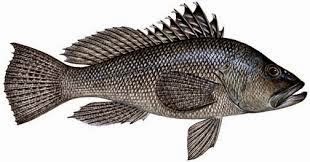
                During the past couple of years, more and more black sea bass have been caught from Maine coastal waters. Most Mainers don’t even know what they look like. Here’s a photo of them. They are one of the tastiest, bottoms feeding fish in the Atlantic Ocean.

                 
                Looks a little like a perch in profile doesn’t it? Well, they school like perch and feed as aggressive and like heavy structure.
                Maine’s Department of Marine Resources just last August established new and the first regulations in Maine waters on black sea bass. The new regulation put in place a daily bag limit for recreational harvesters of 10 fish and a minimum size for both commercial and recreational fish of 13 inches. The season for recreational harvesting is May 18 through September19.
Black sea bass have become more prevalent in Maine waters in recent years so the department determined that it was important to develop regulations that would provide opportunity for both recreational and commercial fishermen while ensuring that this new commercially viable species can be sustained” said Maine Department of Marine Resources Commissioner Patrick Keliher. 
Commercial harvesters fishing in Maine waters will have a daily limit of 50 pounds. In order to fish commercially for black sea bass, harvesters must obtain a DMR Commercial Pelagic and Anadromous Fishing license. Wholesalers who wish to sell black sea bass must also obtain a black sea bass endorsement and must report all transactions weekly to the DMR landings programs.
The method of fishing for both commercial and recreational fishing is hook and line only. 
Black sea bass are a perch-like fish that lives from the Gulf of Maine to Florida. They are mottled smoky gray to dusky brown or blue-black in color, with one long continuous dorsal fin. They live on the bottom, on offshore ledges and banks. According to the Maine Sea Grant’s Maine Seafood Guide, black seas bass is versatile and popular seafood, sold whole and as steaks or fillets, is low in calories and fat, and considered a good source of selenium and omega-3 fatty acids.
How to find black sea bass in Maine waters is a hunt as they aren’t a historic fish that anglers know much about. The best way to start is by looking at nautical charts to locate rocky humps or rocky ridges. They really like rock structure. Use heavy egg or bank sinkers attached to two hooks with a foot or so leaders, about two feet apart. Make certain to use sinkers heavy enough to hold bottom. Carolina style rigs work just fine. Fishing at anchor or by drifting over structure are both productive techniques.  For terminal tackle, I use Temple Fork Outfitters Mangrove Series Rods in nine foot and eight to 12 test line rating with an LL Bean 3000 spin reel filled with 12 or 14 pound, Cortland green Master Braid Premium with a 4 foot,  fluorocarbon leader with a swivel at the end to attach the Carolina rig to.
Being bottom feeders, black sea bass are known to eat crustaceans and mollusks as well as several kinds of small fish. Good baits include marine worms, shrimp, crabs, clams and cut fish. Mackerel jigs are also effective.


Tuesday, February 24, 2015

Time to Prep Gear For The Season

It’s time to gear up and plan for Maine’s 2015 striped bass fishing season.
                Rods, reels, lines, flies, hooks, terminal tackle, clothing, boats and other personal items need to be attended to now, not a few days prior to your first trip to the salt. All those items need to be inspected, repaired, cleaned or replaced to be ready for battles come spring.
                All the pictured fly reels and bags full of fly reels and new fly lines need to be cleaned and have new lines strung. Not torture, but it has to get done prior to the season as there is precious little time available then. Anything you can do to simplify the process is most welcome.

                Several years ago, Jim Young who manages Eastman’s Tackle in Falmouth, MA. showed me his new reel cleaning devise. It consists of a big tub full of a special liquid chemical. He dug out a salt encrusted reel he needed to repair. Watch this he said. As he dunked the reel in a rack into the tub, he explained this was a similar operation that women use to clean jewelry. After a couple of minutes, he retrieved the reel, rinsed it off with cool water and handed to me. That was a “wow” moment. The ugly looking reel that got dunked came out looking almost new. Jim would then proceed to dismantle the reel, clean and lubricate inner parts and replace any worn parts. Reel was quickly refreshed for another year of duty.
                So, I went shopping to find a jewelry cleaning machine and found one easily at a jewelry counter in a local store. Now this machine isn’t the commercial item Jim uses, but it does work on smaller parts of reels as you clean one. Some of the larger parts can be cleaned by holding them in the tub one little section at a time. This is not a fast as Jim’s machine, but it does an admirable job. The chemicals required are readily available at most larger retail outlets. This is much better than I can do by hand.   
                One item I see sports neglect every year is their leader, be it a butt leader or full tapered leader. Every season I have numerous sports show up with their own equipment and I always ask the pound test of their tippet. The usual answer is, “I don’t have clue, it’s the same one I used last year”. I don’t even bother to inspect leaders. All are replaced with appropriate tippets for the intended game. One note on leaders. I always use a knotless, tapered leader for all popper fishing. This will eliminate knots which always catch little and big pieces of debris floating on the surface all season long. It is very annoying to have your leader fouled with debris just when a fish starts to following a fly. The debris is just enough to turn the hot fish away from striking. Another note, if you use tea colored leaders for Atlantic salmon fishing, take it off as I found them not as effective as fluorocarbon leaders in the salt. I think the tea colored leaders show up too much in salt water, potentially spooking fish.
                It’s a pain to strip all your fly line off the reel to inspect the knot between backing and fly line. I have seen dozens of fly lines lost to aggressive fish. Not only do you lose a fish, you lose a $40 to $90 fly line which is connected to a fish. That fish might not drop the line and die from being snagged to kelp or other underwater items. Just retie the connection to eliminate a potential weak spot in your setup.

                Fly rods need a little attention. If you didn’t do it in the fall, take a fly rod a day to the shower with you to clean them carefully using an old tooth brush. Make certain to clean each guide inside out and backwards as this is an area that gets neglected too often. When the rod is dripped dried for a day, inspect every inch for issues. Run a small piece of nylon stocking back and forth through each guide on all 360 degree inside surfaces. If there is a problematic nick in the guide, the stocking will catch up on it. Either carefully file the nick down with fine emery cloth or replace the guide.

Monday, January 26, 2015

Maybe Next Year!!!

                During Maine’s 2014 muzzle loading deer season, I’m sitting on a stand freezing at four degrees Fahrenheit. It had snowed two days prior and I had not seen a deer track since then. Which is typical I have found over the years. I can’t remember a time when I’ve seen deer tracks in deep snow the first two days following snow unless the deer were driven out of thick cover for some reason.
                On the third day following such a storm, I went to one of my stands about five miles from my house. An easy hunt. The area is rich in what deer need to live and survive, making it a regular producer almost every year. A good deer honey hole one could say.  
About 20 minutes prior to afternoon shooting time, I decided the cold was too much and began packing up to close the day’s hunt. It was cloudy, so it was getting dark quickly. I removed my 209 primer, put it away and reached for my scope covers hanging from the nearby branch. Something caught my eye and I looked up. You guessed, a deer was approaching at a slow, deliberate walk. It was a good one. Actually the second largest buck I have seen in many years.
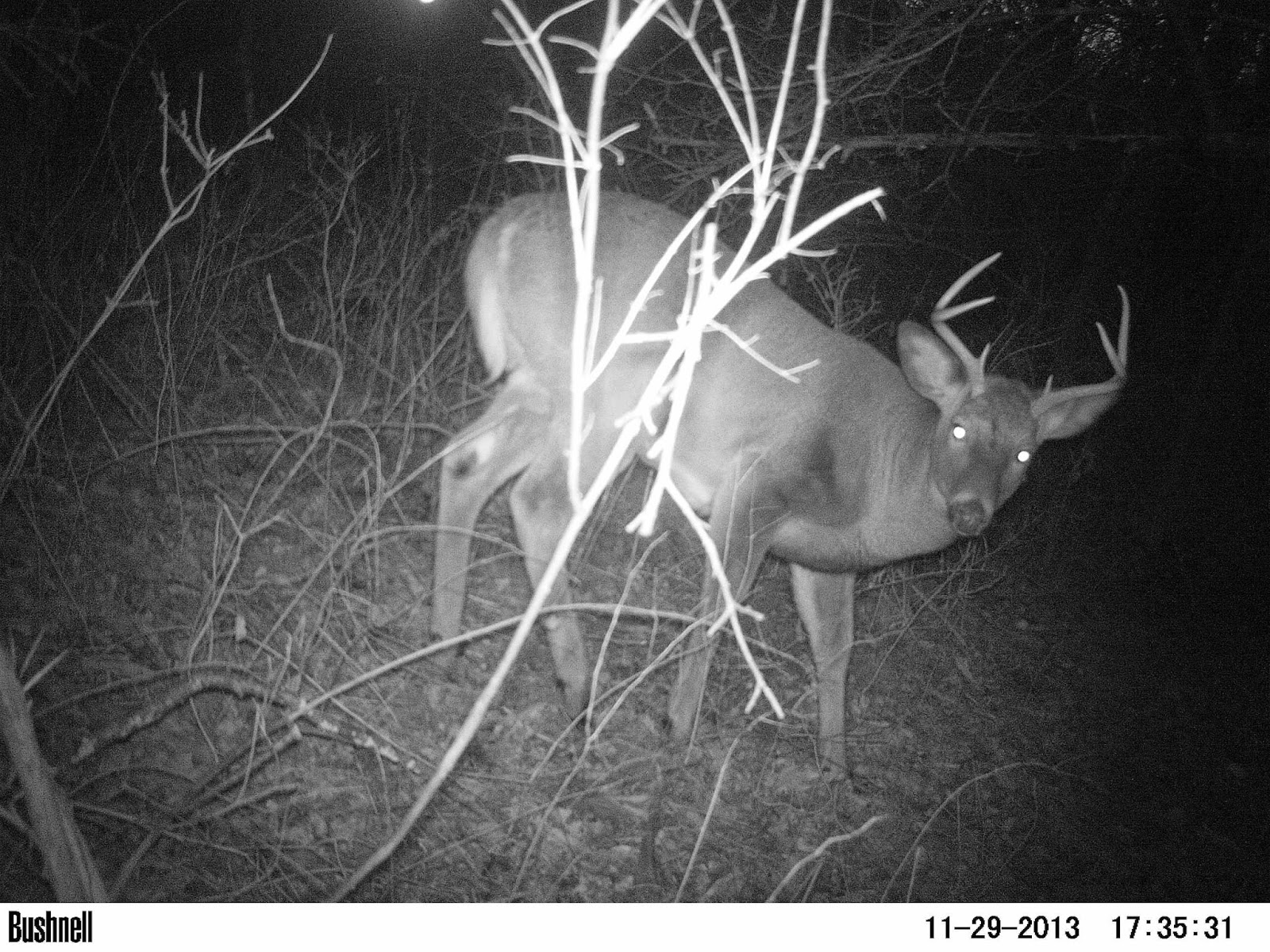
(photo ID – Likely this is the same deer, in the same spot during the fall of 2013)

                What to do? The buck was on track to almost walk under my tree, 25 yards along my shooting lane. Several thoughts passed. One, if I tried to reload the primer, it was likely I could make enough sound to spook the big buck. Second thought was, so what, you can’t shoot an empty weapon. Third, if I spooked the deer I apt to poison the spot and never see him again. I had all this time to think as the deer just stopped, not even alert and then would take a few steps and continue on his way closer to me.  I decided not to attempt a quiet reload and simply enjoy the show and hope the big deer would repeat the walk in the next couple of days.
                The big bodied deer stopped, only 25 yards from me right in the middle of my shooting lane, sniffing some high branches and picking up an occasional acorn, with a crunch, crunch eating sound. It had a nice, evenly spread six point rack. Not a massive, thick rack; just a pretty one. The body was huge, likely one of the largest I’ve ever seen live in the woods. I literally had at least a four minutes or more look at this deer. What a beautiful creature! He lingered about for some time, stepping a few paces to a nearby stream for a drink and then continuing along his feeding way around my stand and behind me, never more that 40 or 50 feet away. He had no idea I was there, never raising his head for suspicious smell detection. Never in all my years hunting has a big, male deer presented such an easy shot and been so relaxed.
                I spent the next three huntable days at this stand as the area wasn’t getting much pressure. Never saw him again. Maybe next year.
                The largest buck of my life came, again after a good snow storm in mid November. For two days I had not found a deer track. I thought, maybe they went into the big cedar swamp. On the third day following the storm I headed deep into the cedar swamp. You now what I mean when I say it is a spooky place; quiet, dark and lonely. Not a track to be found, so I headed out, following my own tracks uphill in the snow. About half way out, I crossed deer tracks, crossing my tracks. Now, I had to go to work and was standing there debating on following the tracks or going to work when I looked up to see a very nice buck following the tracks, nose to ground in hot pursuit, coming straight at me with the breeze blowing straight to the deer’s nose.

                I shouldered my model 94 Winchester, drew a bead and waited. This deer was getting too close, so I pulled the trigger and he dropped. Being alone, dragging a large buck uphill wasn’t fun, but I was younger then and got the job done. The scaled weight, dressed, was 201 pounds on the eight pointer. Still remains as my largest whitetail deer. 

Monday, December 1, 2014

New Striped Bass Regulation Plan Flawed

               Likely you have read the news about possible striped bass conservation measures adopted by the Atlantic States Marine Fisheries Council last fall in Mystic Connecticut at their annual meeting. The short news is a 25 percent decrease in recreational and 20.5 percent decrease in commercial take.  All sounds good, right? Well I am sorry to report that’s not necessarily the case. Striped bass are still in trouble and the ASMFC actions aren't going to help that much. The reason for me saying that is a lengthy subject, too long for this forum. So, I suggest you go to:  http://oneanglersvoyage.blogspot.com/2014/11/striped-bass-bait-and-switch.html  for a lengthy, spot on analysis of the subject. If you are honestly concerned for the future of striped bass fishing in Maine, read the entire blog. Take the time to absorb the contents to understand the complexity of the system.


                The accompanying photo is typical of what happens south of Maine. Those fish are all mature, breeding age female striped bass.  This type of action is likely to continue in the near future despite the devious actions instituted by the Atlantic States Marine Fisheries Council. If you believe the system is rigged in favor of killing versus conservation, you are correct. What can you do to turn the tide? I am miffed on the subject after spending years of concentrated effort to do so. So called conservation organizations continue to be on the debating team rather than getting on the field of play to accomplish a win in favor of conservation. I dislike saying that, but after years of participating with such groups and devoting much time studying, lobbying and attending meetings that likely had the fix already in; I have become jaded.
                Last fall, nine concerned Maine guiding captains rented a 12 passenger van, went to the ASMFC meeting in Mystic, Connecticut to display their support for strong conservation measures that had been hammered out over the past three years. A complicated measure came up for a vote and passed. We were quite happy with the outcome as it seemed like a small victory after many years of battling for striped bass mortality reduction coast wide. If you read the above suggested blog it is clear that we all bought into the snake oil sales pitch. You are not likely to see any further regulation changes for three to five years as the ASMFC process for change takes that long if they want it to. And you can believe they don’t want it to.     The one fish at 28 inches standard stands in place for the entire east coast recreational fishery. The so called conservation equivalency formulas in place are likely to allow states to petition for things like two fish, 23 inches or larger per day to accomplish the equivalency.                
Sounds crazy doesn’t it? But when New Jersey elects that recreational equivalency, states like New York and Rhode Island are likely to do the same. And so it will go up and down the coast. So, we haven’t changed anything except a decrease from two to one fish per day. Your guess is as good as mine as to what Maine will select for a keep limit.
                Maine’s popular slot limit may be allowed but with a tighter length limit such as 22 to 24 inches or 24  to 26 inches with a one fish limit. Maine’s bonus 40 inch plus trophy fish may or may not be allowed within the new conservation equivalency plan.

I for one hope the 40 inch trophy fish is dropped. I never liked it and here’s why. I’m not opposed to the 40 inch fish being taken. It’s the process of getting it that bothers me. A few large fish are taken with artificial lures and flies, but most are taken using bait, especially live lining mackerel. Now that’s all fine and good if you only catch that one fish over 40 inches and call it a day. In reality, the quest for the larger fish means catching several between 30 and 40 inches while using live bait. That means playing, landing and releasing them safely. That’s my issue. To many breeding size fish will die in the process of finding that one 40 inch plus fish. We need more, not fewer breeders in the system to help the recovery. 

Friday, November 21, 2014

What Is A Guide's Real Job?

Memories! That’s what a guide creates. Good or bad.
                There are weather conditions and fish and game availability that a guide can’t control. But, they can control many other things like a clean boat, being on time, being honest, 
providing functional equipment, knowledge of the area and landscape, empathy, good story telling, and a willingness to help the not so talented sports to learn about the quest at hand.
                On any given day a guide meets a sport who is very talented at the quest and on other days is presented with rank beginners. It is the guide’s job to provide a day of activity which is memorable. It doesn’t necessarily mean catching the most or biggest fish or shooting the biggest deer or a limit of winged challenges.
                I had a man and his young son come fishing for striped bass a few years back. The father made it very clear that the day was all for his son. The little guy could hardly cast a small spin rod. I helped him all trip long. Fishing was a little on the slow side, but he did manage to catch a few with his limited talent. During the lull in fishing he got a little cranky. So I made a quick decision to change the trip plan to a nature quest, suggesting he might like to see some seals. Oh yes he would. So we did. And then I suggested we just might find a bald eagle if we got lucky. We did. Would he like to see a family of baby ducks? Yes he would. We did.
                . I said it might be several weeks before he got his pictures. He was disappointed because he wanted to tell his mom how big the fish were.
                The biggest fish he caught was about 14 inches. So I asked him to stretch his arm out straight to the side. I measured from his arm pit down his arm to 14 inches. There, I told him he could show his mother the size. That measure went well beyond his elbow.
                Last year the same father and son team came fishing again after several years had past. The little guy was now much bigger.

                During the day of fishing the now young man said he remembered that big fish he caught on the previous trip. I asked how big. Raising his arm out straight and pointing from his arm pit to the original point on his arm where the fish would have stretched to, this big. . Well, that 14 inch fish memory had grown to a 30 inch fish! We all laughed and his dad said that was a really big fish, ha? Memory created.
Another time I had guided this sport over several years. This day was a cold, mid July day with winds howling out of the southeast. I offered a trip cancellation because of the conditions, but he said no, he wanted to fish.
                He called this winter after many years of not visiting Maine. He had moved to Florida and decided he couldn’t stand it in August and September and wanted to come to Maine during the period to get away from the heat and fish with me a couple days a week.
                During our talk he mentioned the big fish! Oh the memory on that miserable weather day. His wife laughed on the other phone saying, “ya, that photo of the fish has been in our wall ever since”.
                We had been catching medium sized busting fish all morning and getting beat up pretty good by the rough water conditions. It was suggested that I might have honey hole in a lee that might hold a larger fish.
                I pulled into a spot and anchored up, something I rarely do. Quite quickly my sport was onto a big fish using a very small fly. His experience brought the fish in quickly. It was difficult to get the monster in the boat. No question, it was over 50 pounds taken with a 12 pound class leader and a fly I called the Every Ready. The fish was quickly released. Sport shipped his rod in the rack, reached into his vest pocket to haul out his traditional end of the day cigar, prepared it, lit it and took one drag. Then he said, “It’s been a great day Doug, let’s call it.”

                We both agreed that without verification, the fish was likely a tippet class world record. Look at the photo, I think you would agree. Memory created!

Sunday, November 9, 2014

New Fly Rod Development Provides Comfort and Function

New innovations for fly rod development have been fast and furious the past ten years. Most new rods have become lighter, better casting and better fighting tools. Small details sometime go unnoticed. Temple Fork Outfitters new Mangrove series of fly rods have a neat, new feature - a built in hook keeper on the left and right side of the real seat. A groove is on each side of the reel seat that extends, up under the grip, providing a location for the hook to be stored.

The left and right grooves allows storing the fly on the opposite side from the reel handle. I have always disliked hook keepers just in front of the rod grip because I usually keep my index finger lapped over the grip for comfort, control and feel. A traditional  hook keeper is most uncomfortable, pressing against my index finger. So I usually cut them off. Just a little thing, but very functional. This new TFO system eliminates that little problem. Love it.    

Sunday, November 2, 2014

Cape Cod Canal History


If one fishes striped bass in Massachusetts very long, they become aware that the fish is somewhat of a god there. Anglers fish by boat, beach and rock ledges with great skill. Striped bass fishing there is almost a religion.
They are really good at their craft, be it plugging, jigging, live bait or chunk bait fishing. Years of experience has been past down generation to generation. When, where and how to fish for the big ones is well known within fishing families.
One of the where to spots is the famed Cape Cod Canal connecting Cape Cod Bay and Buzzards Bay to the west. Here, shore fishing is the only permitted techniques. Rods, reels and lines are prepared specifically for the location as distant casting is most important. Tidal currents are very strong. When bait enters and is trapped in the canal, it becomes a six mile feeding station for stripers.
The canal has a small, six mile roadway on both sides from end to end. Vehicles are not permitted so people use bikes specifically built for fishing with rod racks and baskets for equipment. Light poles are numbered for reference and each is known to be a good, bad or somewhat ok fishing location.
It has been determined that the Cape Cod Canal fishermen should be memorialized with a bronze statue of a somewhat oversized Canal Rat as they refer themselves as. A plaque identifying the statue reads:  “The Fisherman – A Tribute to Past and Future Striped Bass Fishermen and The Great Cape Cod Canal. Inspired By Local Fisherman Stan Gibbs.” The statue is located at a public park on the off Cape side of the canal near the railroad station in Buzzards Bay (Bourne) Massachusetts.


Thursday, March 13, 2014

Two Handed Rods De-Mystified

Two Handed Fly Rods Growing In Popularity.


Photo Caption:  Double handed fly rods aren't just Spey rods used for Atlantic salmon fishing today. New developments have expanded the concept of using two hands while fly fishing for other species.

photo credit:  Mike Laptew photo of Captain Doug Jowett on Martha's Vineyard, Cape Cod, MA, USA. 

Do you know what a two handed fly rod is? Really, do you know? I suspect that many anglers might say, “Ya, it’s a Spey Rod”. Well, that is one form of double handed fly rod. But, in the past fifteen years and especially the last five; double handed fly rods have been seeing measurable leaps into technological changes as well as applications on the water.
                Spey rods originated out of necessity on the River Spey in Scotland where the river banks are steep and choked with heavy growth, making back casting out of the question.  A need for long casts using roll casts evolved into the use of 15 to 17 foot, two handed rods. They were heavy and early fly lines for them were custom builds by individual sports or guiles. The first lines were heavy floating lines attached to lengths of running line. The designs came from the Atlantic salmon fishing world were the use of any kind of sinking line or flies was frond upon.
                I began using 16 foot Spey rods for Atlantic salmon fishing about 1980 and struggled to learn some of the casting techniques using a floating line of 10 to 15 weight forward lines. I did ok, but not really great. What were needed were more specific fly lines for Spey casting. They were developed for floating lines only.
 As time pasted, other fisheries saw the advent of double handed rod use, especially for steelhead fishing on the west coast where the need for long casts with heavy sink tips were in demand. This demand led to the development of different actions of double handed rods which were faster action as apposed to the European action which lend themselves to the beautiful snake like Spey casting we have all seen. That rod  lead to what now is called a  Skagit rod having the faster action needed to handle short fly line heads weighing  from 300 to 600 grains of weight while fishing steelhead. The name Skagit coming from the river so named in Washington State and British Columbia, Canada.
                I began using my long Spey rods with traditional 500 to 600 grain weight shooting heads and very large flies for striped bass fishing about 1986. This delivery system worked great in the wind using mega flies for presenting to large stripers. One issue was the soft action which didn't fight a fish real fast. Skagit rods became part of the answer to that issue.
                As time passed, double handed rod use has expanded to other fisheries. Demand for rods applicable to trout fishing or smallmouth bass evolved. Switch rods were engineered to accommodate more traditional overhead casting, bring the option of very long casts to those fisheries. Switch rods are rightfully named as anglers can switch from single to two handed techniques without changing the grips. Their lengths tend to be in the ten to 11 foot range, so using single hand casting is doable with the light weight of today’s rod blanks. Line weights range from four to ten with line weights of the head section being from 200 to 700 grains.
                Next comes the most recent additional to the two handed rod development in the form of rods with two butt sections. One section for traditional one hand casting and a second butt section for use of two hands when necessary.
Temple Fork Outfitters now has two lower rod sections designed to replace the single-handed grip section on existing seven and eight weight, nine foot, four piece TiCrX fly rods. With a total of six rod sections of equal length you can now have both, a great nine foot, four-piece traditional fly rod, and a five-piece 11 foot, three inch, two-hander for easy overhead distance casting. This system is being referred to as a convertible rod.
So, there you have it. Double handed fly rods come in the form of Spey, Skagit, switch and convertible configurations. That’s a big change from the previously recognized two handed fly rods being classified into one class called Spey rods.


                Captain Doug Jowett is a Master Maine Guided holding a USCG Captain’s License who charters on the coast of Maine and Cape Cod. He may be reached at: http://www.mainestripedbassfishing.com .

Friday, July 5, 2013

2013 Season Producing Stripers On The Fly - BIG!!!

Having been busy since guiding since May, I forgot to post. Here's a few Photos of the action. Tight Lines.


Friday, March 29, 2013

Cape Cod Striper Flies For the Early Season

Spawning bait is the key for early striped bass fishing on Cape Cod. The earliest bait is  likely to be herring beginning in May followed closely by herring & mackerel, especially while fishing in Buzzards Bay. Herring fly patterns will be good for the waters of the Cape. In Vineyard Sound there will likely be a good run of spawning squid, so - squid flies will work in varying colors there. As the early season progressess into late May and into June there will likely bite a good bite for weeks and sand eels. I like an olive over white Clouser or a large eel pattern.

My go to flies during this time are the chartruese R2-T2, olive clouser minnow and a large squid fly.


GOOD LUCK

Saturday, March 2, 2013

How To Catch Big Striped Bass with A FLY

Below are two links to an in depth article I wrote several years ago about targeting BIG striped bass.


PART 1:   http://www.sportingjournal.com/main27.shtml
PART 2:   http://www.sportingjournal.com/main28.shtml

See my new web site at:   www.mainestripedbassfishing.com

Saturday, February 16, 2013

Circle Hooks Required In Maine on Coastal Waters


 Circle Hooks Required In Maine on Coastal Waters Starting in 2013


Photo ID – Circle hooks with or without barbs are now required by law while bait fishing on Maine coastal waters. NOTE:  Pending rule changes may allow Tub and Worm rigs to use "J" hooks. Check the law before fishing in 2013.

            Striped bass 2013 fishing season in Maine begins soon and with it a new regulation for bait fishermen. Bait fishing will now be required to use non-offset circle  hooks only while bait fishing. The new law reads as follows:  “It is unlawful to use any hook other than a circle hook when using bait. For the purposes of this chapter the definition of circle hook means “a non-offset hook with a point that points 90 degrees back toward the shaft of the hook”.
            The accompanying image illustrates what is legal for Maine striped bass bait fishing and what isn’t. Note the profile image hook point circles around to point towards the shank of the hook. The second image shows the difference between inline and off set hooks. Note the inline hook shows the hook point inline with the shank. If you put the hook on a table the entire hook should lay flat on either side to be legal. You can see that the offset hook would not lay flat if set on a table on either side.

            If you haven’t used circle hooks to fish with, be aware there is a different way to set the hook. It’s this simple. Let the fish run with the bait and when the line comes taught without any effort by you, just lightly set the hook or wait for the fish to hook itself. If you use one of those downtown hook sets from the waters surface to over your shoulder with all the energy you can muster, you are likely to loose every fish you encounter. The hook set method is a little difficult to get used to until you realize it works. Usually the fish will be hooked in the corner of the mouth with no damage done from swallowed bait.
            Fishing on the Kennebec River above legal head of tide is controlled by Maine’s Department of Inland Fisheries and Wildlife which has its own freshwater regulations in place for other species of fish as well as striped bass. There is a closed season there for keeping stripers until July first, the same as the DMR regulations. Other Inland rules stricter than DMR rules govern terminal tackle allowed. Check this rule here:  http://www.eregulations.com/maine/fishing/general-law-limit-information/
            All other Maine saltwater fishing regulations can be viewed at:  http://www.maine.gov/dmr/recreational/documents/2012stripedbassregs.pdf
            Early season striper fishing in Maine usually begins around early to mid May when ocean water temperatures rise above 50 degrees Fahrenheit. Depending on winter runoff in the mighty Kennebec River, the catch and release striped bass fishery will be active without bait until July first. The reason for catch and release and no bait fishing in the designated Kennebec River system is to protect native spawning stripers until the anticipated spawn has completed. 
            You might ask, is the Kennebec River actually producing its own native stock? The answer is yes. Maine’s DMR does an annual young of year sampling study which reveals natural production. It is not known where and when stripers spawn as expensive studies haven’t been done to find out. Historically, striped bass always spawned heavily in the big river until industrial dams were built. We have had several years now with a few dams removed, so striper production along with other indigenous fish continue to show signs of improved development. We just don’t know how good it actually might or could be.
            Don’t forget you need a saltwater fishing registry permit to fish in tidal waters. Go here:  https://www5.informe.org/cgi-bin/online/dmr/swf/index.pl

Friday, February 8, 2013

Maine DMR Striped Bass Scoping Meeting

For details go here:   http://www.facebook.com/MaineStripedBassFishing/posts/484085668317361?notif_t=wall

Tuesday, January 15, 2013

Bill Townsend - Sportsman/Conservationist


Photo ID – “Bill Townsend with at false albacore caught from the waters of Cape Cod, MA.” – Doug Jowett Photo)

       Maine is fortunate to have many active stewards helping to enhance and protect the wilds of the state. All give generously of their time, expertise and finances. Singling one out is always risky at best but always well deserved.
       One man I have known for years fits the formula of an outstanding steward of Maine’s outdoor resources. His name is Clinton (Bill) Townsend of Canaan. He is a young 86 years old and continues to pursue fish and game as well as helping establish protections for the future.
       His sportsman’s interests include fishing for Atlantic salmon, trout, landlocked salmon, smallmouth bass, striped bass, bluefish, false albacore or any other fish that will bend a fly rod. He isn’t married to the fly rod, also enjoying spin and bait casting tackle. Last year he told me he still would like to hook into a small bluefin tuna on a fly rod before he hangs up his fishing equipment.  
       He is passionate about hunting for duck, geese, grouse, woodcock, deer, turkey and other animals of Maine. For a period of time he ran retrievers in field trials. Bill was one of us crazy people who chased eider ducks during the month of January. Some people say crazy, we all say passionate. Maybe there’s a close line there! He also loved sculling up a flock of black ducks or geese on Merrymeeting Bay or on the upper reaches of the Kennebec River.  
       I first met Bill in the 1960’s while we served on Maine’s Waterfowl Advisory Council for eight years. Those were the times when black duck limits and steel shot issues were the order of the day. To say we were busy on the Council in those days is an understatement. Bill helped lead the Council into making the right decisions to decrease black duck limits and establish steel shot regulations. Both issues weren’t very popular with hunters. But, time has proven it was a good call.
       Then there are a couple of organizations called American Rivers and the Natural Resources Council of Maine which Bill was helpful in establishing in the early days of their founding. Both organizations have gone on to establish meaningful regulations protecting Maine’s resources. The North Atlantic Salmon Conservation Organization is the international organization overseeing Atlantic salmon conservation efforts. Bill served on the body for many years. Not to mention the dam removal programs in Maine. The list of natural resource organizations he belongs to and has or is still active in is too long to list here. Let’s just say Bill has paid his dues ten fold over.
       Bill’s spirit to be in the field is admirable. Like most seasoned sportsmen, he has more than his share of health issues but refuses to let that stop him from enjoying is life’s joy of the outdoors. You can see the joy on his face every time he hooks a fish.